
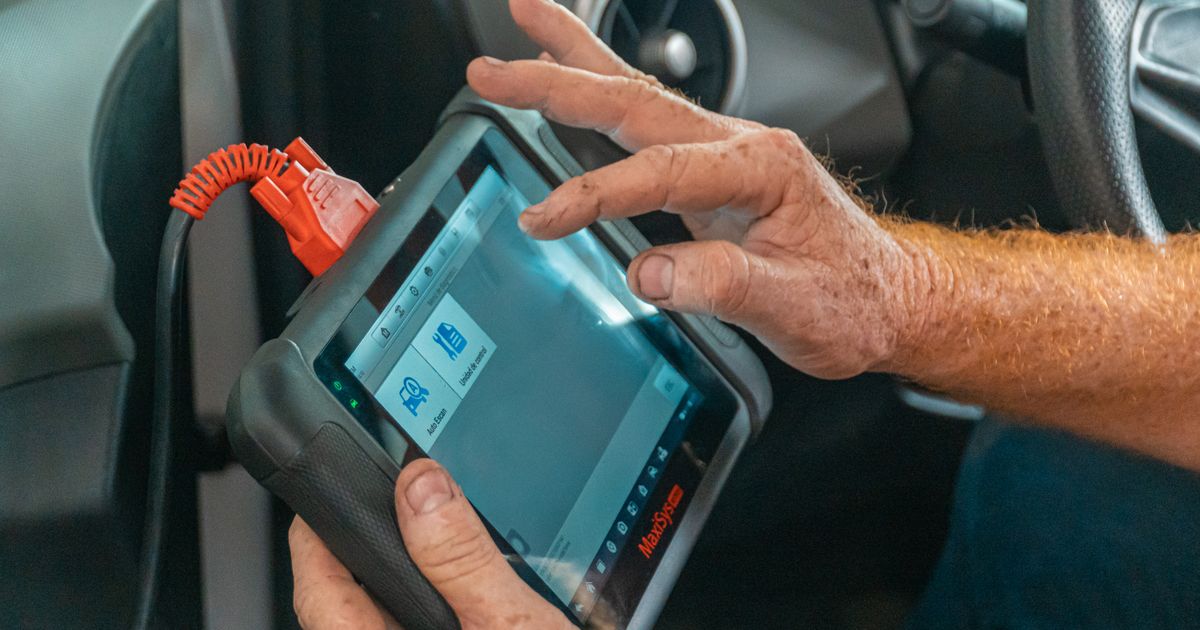

When an EPC warning lamp illuminates, your first task is to record every observable symptom before the vehicle reaches a technician. Note the operating conditions at the moment the lamp appeared, such as engine temperature, road speed, and any unusual sounds. A stored fault code narrows the search for the fault's origin but does not by itself confirm which component has failed. Taking your vehicle to a qualified technician with a full written record of symptoms and codes will help ensure an accurate diagnosis.
To record standard engine and emissions fault codes before making changes, try AutoScan for Windows free trial with a compatible ELM327 adapter.
What the warning indicates
The EPC lamp signals that the vehicle's electronic power control system has detected a fault affecting throttle or engine management operation. Depending on the fault stored, the car may enter a reduced-power mode as a precaution, limiting acceleration to protect components. Because the lamp alone does not identify which component has failed, a diagnostic scan is needed to retrieve the stored fault codes. Until a qualified technician has read and interpreted those codes, it is safest to avoid high-speed or motorway driving.
For further detail, see RAC dashboard warning-light guide guidance.
Decide whether it is safe to continue
If the EPC lamp appears alone and the car runs smoothly, drive cautiously to a nearby garage without further delay. Stop as soon as it is safe to do so if the lamp is accompanied by juddering, stalling, or brake irregularities. An EPC lamp combined with a red warning light, loss of engine power, or unusual braking behaviour warrants stopping immediately. Even when symptoms appear mild, continued driving before diagnosis carries a risk of worsening an unidentified underlying fault.
For further detail, see GOV.UK MOT inspection manual guidance.
Record symptoms and recent events
When the EPC light appears, note any unusual noises or performance issues immediately. Document the exact moment the EPC light turned on, including recent driving conditions and distances travelled. Avoid making assumptions; record all symptoms and engine codes precisely for accurate diagnostics later. Refer to your vehicle's manual for model-specific guidance on interpreting the EPC light and related symptoms.
Use scan data as evidence
Scan data provides objective evidence of issues, helping to identify specific problems with your vehicle. When an EPC lamp appears, consult model-specific guides to interpret scan data accurately. Engine codes from a diagnostic scan should prompt a professional evaluation, not immediate action. Record the exact codes and conditions under which the EPC lamp appeared for thorough analysis.
Checks that do not create extra risk
When the EPC light appears, safely pull over and note the engine codes and conditions without altering the vehicle. Avoid actions that could mask symptoms, such as disconnecting electrical components or adding fluids without guidance. Document any recent driving patterns, such as towing or unusual loads, that might correlate with the EPC light activation. Refer to the vehicle's manual for specific guidance on interpreting and addressing EPC light issues safely.
When to stop and seek help
When the EPC light appears, cease driving immediately to prevent potential engine damage and ensure safety. Seek professional assistance promptly to diagnose and address the underlying issue indicated by the EPC warning. Avoid prolonged driving with the EPC light on, as it may signify severe engine problems requiring expert attention. Consult a qualified mechanic to assess and rectify the engine's condition, ensuring your vehicle's continued reliability.
Use the code as evidence, not a parts list
A diagnostic trouble code identifies the system or test that noticed an unexpected result; it does not prove that the component named in the description has failed. Before clearing anything, save the full code, whether it is stored or pending, the freeze-frame values and any symptoms you observed. Compare those clues with vehicle-specific workshop information. Wiring, air or exhaust leaks, low voltage and related faults can produce similar codes, so replacing the first part mentioned is an expensive way to guess.
Know the limits of a scan
Standard OBD information is useful, but it is only one layer of a diagnosis. Braking, airbag, high-voltage and manufacturer-specific systems may need compatible equipment and trained handling. A scan also cannot confirm that a safety recall has been completed: use the manufacturer or the official GOV.UK recall service. If the car runs roughly, loses power, overheats, shows a red warning, smells of fuel or makes an unusual mechanical noise, stop and seek qualified help rather than continuing a test drive.
Next steps
The EPC light signals potential issues needing professional attention, indicating underlying problems requiring expert investigation. Documenting the EPC light's appearance alongside engine codes aids mechanics in diagnosing the vehicle's condition accurately. Ignoring the EPC warning can lead to escalating issues, compromising vehicle safety and increasing repair costs. Regular checks and prompt professional intervention when the EPC light appears help maintain vehicle reliability and longevity.

Common questions
What should I do when the EPC warning light appears?
Record all observable symptoms, including engine temperature, road speed, and any unusual noises. Document these details and consult a qualified technician for an accurate diagnosis.
How can I use scan data effectively for the EPC light?
Use scan data to identify specific issues but do not assume it confirms a part's failure. Save full codes, including stored and pending, and freeze-frame values for professional evaluation.
Why is it important to avoid prolonged driving with the EPC light on?
Ignoring the EPC warning can lead to escalating issues, compromising vehicle safety and increasing repair costs. Prompt professional intervention helps maintain vehicle reliability and longevity.