
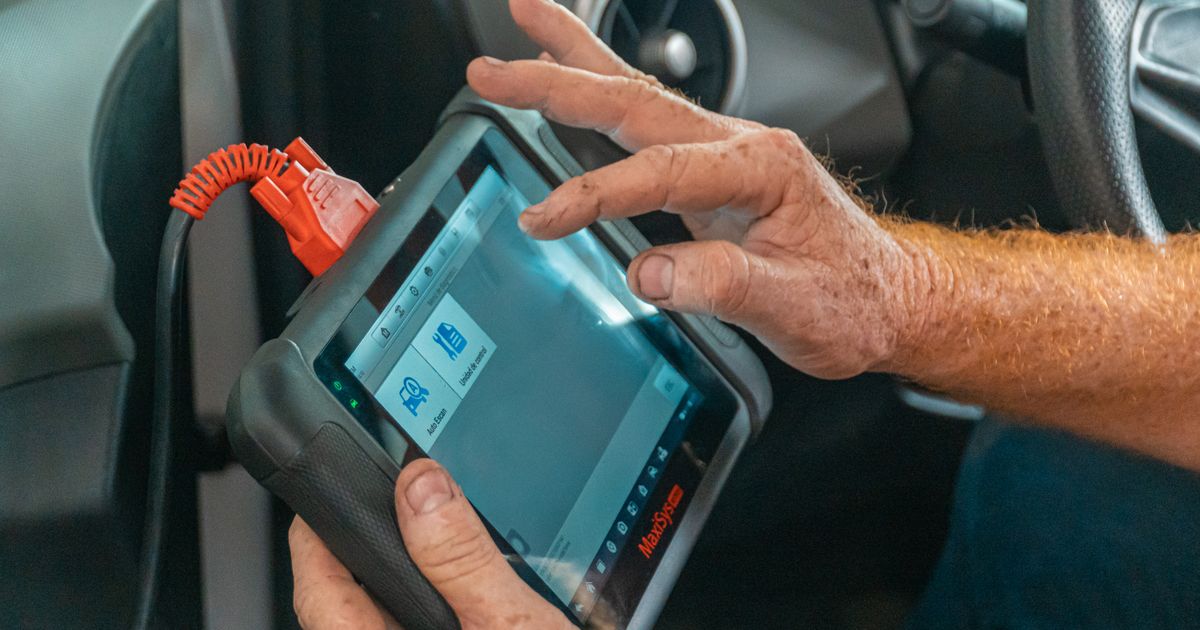

Understanding coolant temperature readings aids in diagnosing the P0128 trouble code without presuming part failure. Practical guidance focuses on interpreting vehicle data rather than making immediate repair decisions. Monitoring engine coolant temperature helps assess the thermostat's functionality and fluid level accurately. Contextual observations of driving conditions and environmental factors inform the analysis of diagnostic codes.
To record standard engine and emissions fault codes before making changes, try AutoScan for Windows free trial with a compatible ELM327 adapter.
What the code records
The P0128 code signals the coolant temperature is lower than expected, indicating a potential issue with the coolant temperature sensor or its circuit. This code triggers when the system detects a coolant temperature below normal operating levels, suggesting a need for further investigation into the sensor's environment or wiring. Monitoring coolant temperature readings alongside the P0128 code helps assess whether the issue lies with the sensor itself or external factors like thermostat malfunction. Understanding the context in which the P0128 code appears, such as recent driving conditions or vehicle modifications, aids in identifying the root cause of the low temperature signal.
For further detail, see SAE J1979 standard overview guidance.
Symptoms and context worth noting
Monitor coolant temperature fluctuations while driving to detect potential issues indicated by P0128 without assuming part failure. Note any unusual temperature readings during cold starts or when the engine reaches operating temperature to inform further investigation. Keep a log of driving conditions and vehicle responses to temperature changes to provide context for a mechanic's assessment. Avoid immediate part replacement based solely on P0128; instead, gather evidence through temperature monitoring and vehicle operation.
For further detail, see US EPA OBD information guidance.
Evidence to save before clearing
Before clearing code P0128, record coolant temperature readings under varied operating conditions to gather evidence. Note the vehicle's response to temperature changes and engine load to understand P0128's context better. Document any deviations from normal operation, such as erratic temperature gauge readings or warning light behaviour. Use this documented evidence to inform subsequent diagnostic steps without prematurely clearing the fault code.
Possible system-level causes
Monitor coolant temperature and vehicle operation to assess P0128 without presuming a specific part failure. Consider thermostat function, coolant flow, and sensor accuracy when addressing P0128, avoiding premature part replacement. Evaluate coolant level, radiator efficiency, and engine block temperature for P0128, ensuring comprehensive system understanding. Review vehicle log for consistent P0128 occurrences; correlate with ambient temperature and driving conditions for insights.
A sensible diagnostic sequence
Monitor coolant temperature and observe how it correlates with engine operation and external conditions for P0128. Record temperature readings during warm-up, driving, and idle to spot trends related to the coolant sensor's input. Compare observed temperature fluctuations with manufacturer specifications for a nuanced understanding of system health. Avoid immediate part replacement; instead, correlate multiple diagnostic readings for a comprehensive assessment.
When professional diagnosis is safer
Professional mechanics use diagnostic tools to interpret complex vehicle data accurately, avoiding guesswork. A thorough diagnostic by experts ensures all underlying issues are identified, enhancing vehicle safety and reliability. Ignoring a diagnostic code like P0128 without professional insight risks overlooking critical system interactions. Expertise in interpreting coolant temperature sensor data prevents unnecessary replacements and ensures vehicle health.
Use the code as evidence, not a parts list
A diagnostic trouble code identifies the system or test that noticed an unexpected result; it does not prove that the component named in the description has failed. Before clearing anything, save the full code, whether it is stored or pending, the freeze-frame values and any symptoms you observed. Compare those clues with vehicle-specific workshop information. Wiring, air or exhaust leaks, low voltage and related faults can produce similar codes, so replacing the first part mentioned is an expensive way to guess.
Know the limits of a scan
Standard OBD information is useful, but it is only one layer of a diagnosis. Braking, airbag, high-voltage and manufacturer-specific systems may need compatible equipment and trained handling. A scan also cannot confirm that a safety recall has been completed: use the manufacturer or the official GOV.UK recall service. If the car runs roughly, loses power, overheats, shows a red warning, smells of fuel or makes an unusual mechanical noise, stop and seek qualified help rather than continuing a test drive.
Next steps
Review coolant temperature readings and operational context to understand P0128 without presuming part failure. Avoid jumping to part replacement; instead, gather evidence through temperature and operational data. Consider consulting a professional for thorough diagnostics if the issue remains unclear after observation. Ensure all recorded data is saved before clearing codes to maintain a complete diagnostic history.

Common questions
What does the P0128 code indicate?
The P0128 code signals a coolant temperature lower than expected, suggesting issues with the coolant temperature sensor or its environment, not necessarily a part failure.
Why is it important to monitor coolant temperature with P0128?
Monitoring coolant temperature helps assess the thermostat's functionality and fluid level, providing context for the P0128 code and avoiding premature part replacement.
What should be documented before clearing the P0128 code?
Record coolant temperature readings under varied conditions, noting any unusual readings or vehicle responses, to inform further diagnostic steps without clearing the code.